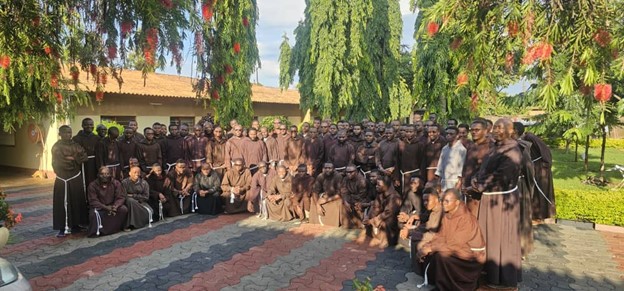
The Capuchin Friars Minor trace their origins back to the early 16th century. The reform movement that led to the establishment of the Capuchins began in 1525, when Matteo da Bascio, a Franciscan friar, sought a more austere and contemplative life in following the example of St. Francis of Assisi. He desired a return to the original form of Franciscan life, emphasizing poverty, simplicity, and prayer, and lived with a stricter adherence to the ideals of St. Francis. The movement was formally recognized by Pope Clement VII in 1528 with the papal bull Religionis Zelus.
Initially, the Capuchins were part of the larger Franciscan family but later became an independent branch, distinct for their commitment to evangelization, preaching, and service to the poor. By the early 17th century, the Capuchins had spread rapidly throughout Italy and beyond, eventually reaching missionary lands in Africa, Asia, and America. Their commitment to a simple life, care for the sick, and dedication to the poor became hallmarks of the Order.
In the modern era, the Capuchins have continued their missionary work across the world, notably in regions like Africa, Asia, and Latin America. They are also engaged in pastoral care, education, and social services in countries where they have established a presence. The Capuchin friars play a significant role in the spiritual formation of youth and vocational training, with a focus on forming future friars in the ways of Franciscan humility and service.
One notable example of Capuchin presence in Africa is their work in Zambia, where they have been engaged in missionary activities, teaching, and providing healthcare for over 90 years. They focus on building relationships within local communities while offering spiritual guidance, medical care, and education.
The Capuchin spirituality remains deeply rooted in the simplicity of life, with their habit, a brown robe with a pointed hood (capuche) serving as a visible sign of their commitment to poverty and humility. They are especially known for their preaching and missions, where they engage directly with the people, fostering a deep sense of community and service to the marginalized.
The Capuchins also contributed to education and formation, founding seminaries and centers for philosophical and theological studies. Many friars engaged in teaching, both within the Order and in public institutions. Some became renowned preachers, theologians, and confessors, including St. Lawrence of Brindisi, a Doctor of the Church, and St. Padre Pio, a mystic and spiritual guide of the 20th century.
At St. Bonaventure University, Capuchin friars join fellow Franciscan students in pursuing philosophy and Franciscan studies, integrating prayer, study, and community life. To today the university hosts about 76 students from different African countries, reflecting the Order’s commitment to intellectual and spiritual formation.
The Capuchins’ journey continues today in many parts of the world, where they focus on humanitarian work, formation of future friars, and evangelization. In places like St. Bonaventure University, the Capuchins play an important role in forming future leaders and spiritual guides through their educational and spiritual programs.
“Come and see”